This is the latest of the local news bulletins produced by my journalism course at the University of Winchester. This bulletin contains part of a continuing piece on the Hampshire Police
Commissioner post; The closure of a Southampton Ford factory; A look at
the local effect of Storm Sandy in the USA; Football and ice hockey from the local Hampshire teams,
and a pub on wheels, now I know that's got your attention!
Any criticism or advice is more than welcome.
There's also much more to see on our site, have a
browse!
http://winol.co.uk/
Wednesday, 31 October 2012


Tuesday, 30 October 2012
Defamation & Libel 2.0
As part of recapping the lawful aspect of my youth, i.e. two years ago, we had a lecture discussing defamation and what it means for us (journalists).
For my point of view, which is to say a broadcast angle of the news. What you broadcast about someone is defamatory if it tends to (the wording is important here as, should a defamation case come to court, the level of proof only has to show that a statement 'tends' to do be defamatory. There's no "beyond all reasonable doubt" here):
And finally,
With film, it can be easy to accidentally defame a person or company if you are not careful with your shots. Often, juxtaposition of a shot, with another, or coupled with a voice over, can end up with what can be (and often will be) perceived as defamation.
Let's say you are making a package about dodgy retailers (or some such thing), and you have cut-aways of a high street with shop signs visible. You have potentially defamed these shops by implying that they are dodgy retailers (or some such thing).
An obvious thing to help prevent accidental defamation is to ensure that, when filming, you film the correct building that your story concerns; as well as this make sure you name the correct people involved in your story. in many cases, you can't have too much identification i.e: Name, age, occupation, where they live; above all: a picture! (just make sure it's definitely the right person!) This is especially true of court reporting, you don't want to risk someone else having the same name/ job etc as the person you're reporting on.
An important point to make about defamation is that you cannot defame someone who is dead. I'm not saying go nuts with it, but it is allowed. As a current example, look at what's going on with Jimmy Savile at the moment. Technically, calling him a paedophile now, is not defaming him as he's dead. Doing it when he was alive, would have been.
Now defamation is hugely important in libel. For something to be libellous, it must meet three criteria:
The easiest way to avoid being sued is to go through a checklist in your head. Perhaps most obviously:
Some fairly recent defamation cases worth at least googling include: Chris Jefferies and his treatment by newspapers during the Joanna Yates murder investigation; Charlotte Church; and Sussex tutor Luke Cooper.
Stay tuned for more posts on media law in coming weeks.
For my point of view, which is to say a broadcast angle of the news. What you broadcast about someone is defamatory if it tends to (the wording is important here as, should a defamation case come to court, the level of proof only has to show that a statement 'tends' to do be defamatory. There's no "beyond all reasonable doubt" here):
- Lower them in the estimation of right-thinking people -This is fairly self explanatory, if a normal person hears what you've said and thinks: "I now think less of the person who is subject of that report" then you have defamed the subject;
- Cause the person to be shunned or avoided - Once again, this should need little explanation. If someone is not generally shunned or avoided, and following what you broadcast, they become so, you have defamed them;
- Disparage the person in his/her business, trade, office, or profession - This would happen if you were to broadcast that your subject was terrible at their job, or was an unreliable person;
And finally,
- Expose the person to hatred, ridicule, or contempt -Let's use an extreme example here and say you've called someone a paedophile. I think it's safe to assume that will expose them to plenty of hatred, not to mention contempt and ridicule.
With film, it can be easy to accidentally defame a person or company if you are not careful with your shots. Often, juxtaposition of a shot, with another, or coupled with a voice over, can end up with what can be (and often will be) perceived as defamation.
Let's say you are making a package about dodgy retailers (or some such thing), and you have cut-aways of a high street with shop signs visible. You have potentially defamed these shops by implying that they are dodgy retailers (or some such thing).
An obvious thing to help prevent accidental defamation is to ensure that, when filming, you film the correct building that your story concerns; as well as this make sure you name the correct people involved in your story. in many cases, you can't have too much identification i.e: Name, age, occupation, where they live; above all: a picture! (just make sure it's definitely the right person!) This is especially true of court reporting, you don't want to risk someone else having the same name/ job etc as the person you're reporting on.
An important point to make about defamation is that you cannot defame someone who is dead. I'm not saying go nuts with it, but it is allowed. As a current example, look at what's going on with Jimmy Savile at the moment. Technically, calling him a paedophile now, is not defaming him as he's dead. Doing it when he was alive, would have been.
Now defamation is hugely important in libel. For something to be libellous, it must meet three criteria:
- It must have been published
- It must have been defamatory
- The subject must have been identified
- Justification - It's true and you can prove it.
- Fair comment - Honestly held opinion based upon facts or privileged material
- Privilege - Protection for journalists in court reporting.
- Bane and antidote - This is when the defamatory statement etc. is somehow shown not to be defamatory with context. The precedent for this was set in 1835 when a judge said that if in one part of a publication something disreputable to the claimant was stated that was removed by the conclusion, 'the bane and antidote must be taken together'.
- Apologies and clarifications - These must usually be made contemporaneously.
- Reynold's Defence - A series of points journalists must follow, to obtain common law qualified privilege. A full description of the points can be found here (scroll about halfway down to find them.
The easiest way to avoid being sued is to go through a checklist in your head. Perhaps most obviously:
- Who am I writing about, and are they very litigious?
- Is what I'm writing about potentially defamatory? - If so, ask your superiors (essentially pass the buck) or lawyers. You should always be scared of being defamatory, unless your defence is absolutely airtight.
Some fairly recent defamation cases worth at least googling include: Chris Jefferies and his treatment by newspapers during the Joanna Yates murder investigation; Charlotte Church; and Sussex tutor Luke Cooper.
Stay tuned for more posts on media law in coming weeks.
Saturday, 13 October 2012
Copyright 3.0: Fair Dealing Strikes Back!
Firstly, I feel that I should explain that as part of my Journalism course at the University of Winchester, we are required to take two modules in media law. The first, in our first year of university, to give us a grasp of what not to do as beginner journalists. The second module starts in our third (and current) year, and is designed to bring us up to speed on any recent changes in the law, or any cases relevant to our interests. Most noticeably at the moment is the Leveson inquiry, which will almost certainly have a major impact on our working careers.
To bring you up to speed, last week we had a lecture on copyright by Peter Hodges essentially a dos and don'ts for journalists. Mr Hodges gave a similar lecture during my first year which I wrote about here, so I wont go into too much detail on the basics on this post. Instead I'm going to talk about fair dealing which is a very important thing to get around, and very useful if you know how to use it.
Fair dealing as described by McNae's essential law for journalists can be used 'for the purpose of reporting current events. essentially meaning that it is OK to use a small amount of copyrighted material if a news story needs it to help explain something. It should always bring something to the story, however, and does not count as fair dealing if it is simple there to bulk out a piece. Fair dealing can always be used for the purposes of criticism and review. This means that if you were reviewing a movie, a video game, or a piece of music; you are allowed to use a small amount of the copyrighted material. How much you are allowed to use isn't clear in the law, and it's easy to be put off by uncertainty, but this was something I expressed to Mr Hodges, who, as the former head of BBC Copyright should have a very good idea on what is acceptable.
He said that for the purposes of criticism and review, you can use an aggregate of two minutes for each subject. the clips can be long or short, but no more than two minutes.
Below is a short review show written and edited by yours truly. We showed this to Peter Hodges and he said it was absolutely safe in terms of fair dealing. It had no more than two minutes of footage for each game, and the details of the copyright holders are clearly displayed throughout. Essentially, this is what you have to do to be able to use copyrighted footage:
You'll have to excuse the dodgy puns and crappy audio mixing. It was my first attempt at something like this and if it makes you fell better, I cringe everytime I watch it. Think of it this way: visually and aurally, this is a bit of a train wreck; But as far as the letter of the law goes, this is excellent. Some other quick points that were covered in the lecture: When filming live events, you are not at fault if copyrighted music is audible as this is accidental inclusion; if however you then recorded the copyrighted material in a package, you could be in trouble. this can prove tricky when filming live events such as sports games and will definitely have to be thought about when editing.
Also, everything said about fair dealing above, does not ring true for photographs. You must always have the copyright holder's permission to use any photo. for example, do you see any pictures in this blog post?
No, you don't.
To bring you up to speed, last week we had a lecture on copyright by Peter Hodges essentially a dos and don'ts for journalists. Mr Hodges gave a similar lecture during my first year which I wrote about here, so I wont go into too much detail on the basics on this post. Instead I'm going to talk about fair dealing which is a very important thing to get around, and very useful if you know how to use it.
Fair dealing as described by McNae's essential law for journalists can be used 'for the purpose of reporting current events. essentially meaning that it is OK to use a small amount of copyrighted material if a news story needs it to help explain something. It should always bring something to the story, however, and does not count as fair dealing if it is simple there to bulk out a piece. Fair dealing can always be used for the purposes of criticism and review. This means that if you were reviewing a movie, a video game, or a piece of music; you are allowed to use a small amount of the copyrighted material. How much you are allowed to use isn't clear in the law, and it's easy to be put off by uncertainty, but this was something I expressed to Mr Hodges, who, as the former head of BBC Copyright should have a very good idea on what is acceptable.
He said that for the purposes of criticism and review, you can use an aggregate of two minutes for each subject. the clips can be long or short, but no more than two minutes.
Below is a short review show written and edited by yours truly. We showed this to Peter Hodges and he said it was absolutely safe in terms of fair dealing. It had no more than two minutes of footage for each game, and the details of the copyright holders are clearly displayed throughout. Essentially, this is what you have to do to be able to use copyrighted footage:
You'll have to excuse the dodgy puns and crappy audio mixing. It was my first attempt at something like this and if it makes you fell better, I cringe everytime I watch it. Think of it this way: visually and aurally, this is a bit of a train wreck; But as far as the letter of the law goes, this is excellent. Some other quick points that were covered in the lecture: When filming live events, you are not at fault if copyrighted music is audible as this is accidental inclusion; if however you then recorded the copyrighted material in a package, you could be in trouble. this can prove tricky when filming live events such as sports games and will definitely have to be thought about when editing.
Also, everything said about fair dealing above, does not ring true for photographs. You must always have the copyright holder's permission to use any photo. for example, do you see any pictures in this blog post?
No, you don't.
Tuesday, 3 April 2012
WINOL Bulletin - Lighting Plan
Since our bulletin of 21/3/12 it's been decided that we have to put more of a focus on our lighting set-up. we only really started using lighting properly as of a few weeks ago, before that we pretty much relied solely on the house lights and a couple of the overhead ones (I'm not great on technical terms).
More often than not we were left with something approaching this:
Myself, Henry, Ali and Graham got lighting training at that point which allowed us to book out various lighting kits, the ones we use are the Satchler and Arri kits. The Arris are the more powerful lights which we use to illuminate the green screen curtain. The Satchlers are smaller lights which we use to light the presenters.
Here is a very simple layout of how we try to set up the gallery:
Needless to say, sometimes we may have to change the set-up for individuals for height etc, but only slightly.
In the first week we were still tinkering with how we were going to set them up. He had them in (roughly) the right kind of positions but we think the main light was to bright, as you can see here:
This is probably the best lighting we've had. There are still some shadows but those are pretty unavoidable and if you look, you can see them on the BBC and ITV presenters etc.
Here, the side of Aarran's face is being shadowed by the guest's body.
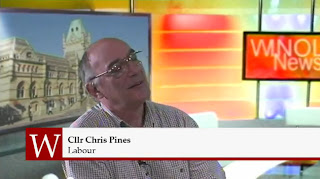
The guest's face is almost fully in shadow as we couldn't point any lights into his face without blinding him.

Even when looking forward, Rachel is mostly in shadow, since the lights were still set up for the guest looking to the side.
It might be best if we keep experimenting with lights as we go, until we find a good solution, at which point I'll update my blog with a floor plan and description (perhaps, actively changing the lighting setup between during VTs. For the meantime, if we have a guest in the studio we should maybe have the house lights on, as well as some of our other overheads, and satchlers/arris etc. This may risk under-eye shadow but, hopefully it will provide more light than we could otherwise plan for.
One extra issue we've found with using lighting, is that sometimes the arris lighting the green screen reflects green light onto the desk. The desk being a shiny surface means this happens quite easily. We've found that using diffusers can help this, but we've also considered having some kind of, for all intents and purposes, tablecloth for the desk.
------------------------------------
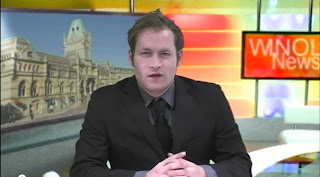
Since writing this piece, one of our bulletins had the best lighting for the news presenter that we've had:
 As you can see we have virtually no shadow. For this, we moved the Satchlers to eye level, and added a few diffusers to try and stop there being too much brightness. The only problem we had was once we moved to the sports presenter:
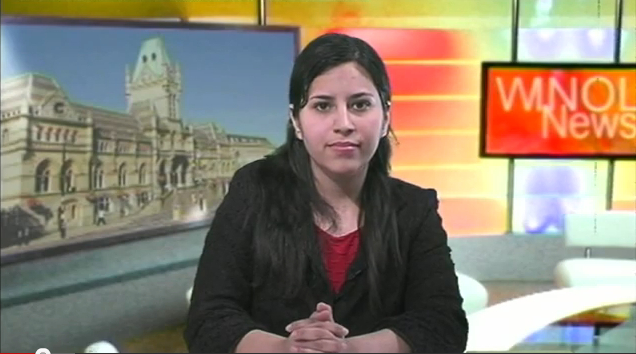
 As you can see, the face is too brightly lit, yet she didn't complain of being at all blinded by the lights. We think that we had one of the overhead lights directly on her. This is easy to remedy by simply turning down the light slightly.
More often than not we were left with something approaching this:
 |
| Notice the green halo around Tom |
Here is a very simple layout of how we try to set up the gallery:
 |
| (Redhead=Arri) |
In the first week we were still tinkering with how we were going to set them up. He had them in (roughly) the right kind of positions but we think the main light was to bright, as you can see here:
 |
| The left side of her face is noticeably brighter than the other |
To remedy this next week we bought some diffusers from the loan counter to bring down the intensity of the main light.
 |
The main problem we came across when filming 21/3/12 was the setup we'd settled on, wouldn't work, as Aarran would be talking to the in studio guest. This meant they would both be looking along the desk towards each other, resulting in them looking directly into the side satchlers. Effectively blinding them. To attempt to remedy this we moved the satchlers further away and added extra diffusers to them and several more of the lights. This worked from the point of the presenters, but not from the cameras POV:


The guest's face is almost fully in shadow as we couldn't point any lights into his face without blinding him.

Even when looking forward, Rachel is mostly in shadow, since the lights were still set up for the guest looking to the side.
It might be best if we keep experimenting with lights as we go, until we find a good solution, at which point I'll update my blog with a floor plan and description (perhaps, actively changing the lighting setup between during VTs. For the meantime, if we have a guest in the studio we should maybe have the house lights on, as well as some of our other overheads, and satchlers/arris etc. This may risk under-eye shadow but, hopefully it will provide more light than we could otherwise plan for.
One extra issue we've found with using lighting, is that sometimes the arris lighting the green screen reflects green light onto the desk. The desk being a shiny surface means this happens quite easily. We've found that using diffusers can help this, but we've also considered having some kind of, for all intents and purposes, tablecloth for the desk.
------------------------------------
Since writing this piece, one of our bulletins had the best lighting for the news presenter that we've had:


Friday, 23 March 2012
Seminar paper - Wittgenstein - Tractatus Logico-philosophicus
Wittgenstein (W) was born in Vienna in 1889, into a large and wealthy family. After being home schooled until he was 14 he attended Realshule at Linz, with contemporaries such as Adolf Hitler.
W read Russell’s Principles of mathematics, and through doing so, became acquainted with Frege, whom he eventually met, and following his advice, studied at Cambridge under Russell.
After living a solitary life in Norway, he enlisted for the Austrian artillery after the war broke out in 1914. During his time in the military, he devised a series of philosophical thoughts, which, during his imprisonment, he turned into his only philosophical book, Tractatus Logico-Philosophicus. The book was published in Germany in 1921, and shortly afterwards in England, translated into English, with an introduction by Russell.
W’s book was the start of a type of rational thinking called logical positivism, greatly thought of amongst members of the Vienna circle, which I will return to later.
Kenny, in Philosophy in the Modern World calls Tractacus “short, beautiful, and cryptic.” It is written, not so much as a philosophical argument or theory, but simply as a series of statements. It is broken up into seven, short, declarative chapters, most of which are accompanied by a large number of footnotes. Chapter one, for example, states that: “The world, is all that is the case.” This is a relatively simple idea, that can be followed easily in terms of a cursory reading, but for any kind of logic to apply to it, we have to know what is meant by “the case.” chapter one, for example, is followed by several footnotes, including:
1.1: The world is the totality of facts, not of things.
1.11: The world is determined by the facts, and by their being all the facts.
1.12: For the totality of facts determines what is the case and whatever is not the case.
Etc.
The footnotes are used to expand each idea, attempting to explain each opening statement. But in most cases the additional footnotes require more explanation themselves, this can result in there being over 50 footnotes, as there are for chapter three, each trying to explain the assertion that “a logical picture of facts is a thought” and often requiring that when a footnote explains another, it may not explain the assertion, so much as create more questions surrounding it. For example
3.12: I call the sign with which we express a thought a propositional sign. And a proposition is a propositional sign in its projective relation to the world.
W is then forced to further explain his definition of a proposition, as without being truly defined, there can be no true logic.
3.13 A proposition, therefore, does not actually contain its sense, but does contain the possibility of expressing it (The content of a proposition means the content of a proposition that has sense.) A proposition contains the form but not the content, of its sense.
Clearly this has not fully explained what he means, and is followed by further and further explanation, resulting in the aforementioned 50 plus statements, which are then followed by further chapters designed to help explain the previous ones.
Chapter three, ends with:
3.5: A propositional sign, applied and thought out, is a thought.
Chapter four picks up from this, and starts to explain what a thought is (A proposition with a sense). And chapter five discusses what proposition is. Chapter six moves somewhat away from the language side and begins to look at mathematics and logic as a way to explain a proposition:
6: The general form of a truth function if [p, E, N (E)]. this is the general form of a proposition
In this, P stands for all atomic propositions, E stands for any subset of propositions, and N stands for the negation of all propositions making up E.
Supposedly this says the same as a theorem produced by Henry Sheffer, that a logical sentence can be derived from a series of NAND operations concerning the totality of atomic propositions (a NAND operation being a logical operation on two logical values, which produces a value of true, if at least one of the prepositions is false)
Later in chapter six, W changes tack somewhat. Having spent most of the book attempting detailed definitions and explanations on almost everything he has discussed, he claims that there can be no proposition of ethics, as: “propositions can explain nothing that is higher.” he says that there is no way to put ethics into words, they are “transcendental” there appears to be some disagreement here as to what exactly W means by this. It is possible that logical positivists would argue against his assertion that any attempt to discuss them a meaningless endeavour. A logical positivist may argue that anything can be discussed can be defined. In “The new Wittgenstein” it is argued that W means, in a similar fashion to Kant, that if ethics are used in empirical sciences, they are destroyed. And they are also destroyed if attempted to use with synthetic, a priori judgements.
W begins to veer toward religious considerations. He talks of will, and its relation to ethics; as well as death, and what happens to the world after it: “…at death the world does not alter, but comes to an end.” “death is not an event in life: we do not live to experience death.”
It seems to me that in the final few statements of chapter six, W has given up any attempt at explaining each of his statements. It appears more as if he is simply jotting down thoughts that he cannot explain: “How things are in the world is a matter of complete indifference for what is higher. God does reveal himself in the world.” By “higher” he may mean God, in which case he is saying that God does not care about anything that happens in the world. This may explain the strange way the book ends. After explaining in great detail, his version of, essentially, how to think. He says firstly that there are things that cannot be explained, and that these are “mystical.” and then, that once you fully understand what he means, you will see that it is all senseless “He must, so to speak, throw away the ladder, after he has climbed up on it.”
He ends his book with the bizarre chapter that consists of the single line: “What we cannot speak about we must pass over in silence.” Perhaps he is saying that he has covered everything of importance and nothing else is worth speaking of. Or that, once recognising that everything he has said, is senseless, there is no reason to talk about it anymore.
The Vienna circle was a group that followed much from W. they had a shared attitude of philosophy that revolved around what became referred to as logical positivism. Taken from Tractatus they asserted that all knowledge should be set to a series of rules using a language of science and rational reconstruction which replaced ordinary language with much better suited equivalencies. They claimed that logic and mathematics, along with science, were the universe of meaningful judgements, and nothing else was of any relevance, ethics, aesthetics etc. The influence of logical positivism and the Vienna Circle (coming from Tractatus), has spread across the world due to eminent philosophers having dispersed as a result of the second world war. The resulting work from those of the circle has contributed to advances in language (Ayer) as well as redefining the scientific method, with the verification principle which ensured a statement could either be analytic or capable of being verified. This was later discredited with falsification, which demands that to be scientific, a hypothesis must be able to be contradicted e.g. all swans are white, can be falsified as it is possible to find a swan which is not white.
Despite the apparent insistence by W that logical positivism was a misreading of his book, it is undeniable that the effect his book has been used as a focal point for many of the great jumps in philosophy and science of the twentieth century.
W read Russell’s Principles of mathematics, and through doing so, became acquainted with Frege, whom he eventually met, and following his advice, studied at Cambridge under Russell.
After living a solitary life in Norway, he enlisted for the Austrian artillery after the war broke out in 1914. During his time in the military, he devised a series of philosophical thoughts, which, during his imprisonment, he turned into his only philosophical book, Tractatus Logico-Philosophicus. The book was published in Germany in 1921, and shortly afterwards in England, translated into English, with an introduction by Russell.
W’s book was the start of a type of rational thinking called logical positivism, greatly thought of amongst members of the Vienna circle, which I will return to later.
Kenny, in Philosophy in the Modern World calls Tractacus “short, beautiful, and cryptic.” It is written, not so much as a philosophical argument or theory, but simply as a series of statements. It is broken up into seven, short, declarative chapters, most of which are accompanied by a large number of footnotes. Chapter one, for example, states that: “The world, is all that is the case.” This is a relatively simple idea, that can be followed easily in terms of a cursory reading, but for any kind of logic to apply to it, we have to know what is meant by “the case.” chapter one, for example, is followed by several footnotes, including:
1.1: The world is the totality of facts, not of things.
1.11: The world is determined by the facts, and by their being all the facts.
1.12: For the totality of facts determines what is the case and whatever is not the case.
Etc.
The footnotes are used to expand each idea, attempting to explain each opening statement. But in most cases the additional footnotes require more explanation themselves, this can result in there being over 50 footnotes, as there are for chapter three, each trying to explain the assertion that “a logical picture of facts is a thought” and often requiring that when a footnote explains another, it may not explain the assertion, so much as create more questions surrounding it. For example
3.12: I call the sign with which we express a thought a propositional sign. And a proposition is a propositional sign in its projective relation to the world.
W is then forced to further explain his definition of a proposition, as without being truly defined, there can be no true logic.
3.13 A proposition, therefore, does not actually contain its sense, but does contain the possibility of expressing it (The content of a proposition means the content of a proposition that has sense.) A proposition contains the form but not the content, of its sense.
Clearly this has not fully explained what he means, and is followed by further and further explanation, resulting in the aforementioned 50 plus statements, which are then followed by further chapters designed to help explain the previous ones.
Chapter three, ends with:
3.5: A propositional sign, applied and thought out, is a thought.
Chapter four picks up from this, and starts to explain what a thought is (A proposition with a sense). And chapter five discusses what proposition is. Chapter six moves somewhat away from the language side and begins to look at mathematics and logic as a way to explain a proposition:
6: The general form of a truth function if [p, E, N (E)]. this is the general form of a proposition
In this, P stands for all atomic propositions, E stands for any subset of propositions, and N stands for the negation of all propositions making up E.
Supposedly this says the same as a theorem produced by Henry Sheffer, that a logical sentence can be derived from a series of NAND operations concerning the totality of atomic propositions (a NAND operation being a logical operation on two logical values, which produces a value of true, if at least one of the prepositions is false)
Later in chapter six, W changes tack somewhat. Having spent most of the book attempting detailed definitions and explanations on almost everything he has discussed, he claims that there can be no proposition of ethics, as: “propositions can explain nothing that is higher.” he says that there is no way to put ethics into words, they are “transcendental” there appears to be some disagreement here as to what exactly W means by this. It is possible that logical positivists would argue against his assertion that any attempt to discuss them a meaningless endeavour. A logical positivist may argue that anything can be discussed can be defined. In “The new Wittgenstein” it is argued that W means, in a similar fashion to Kant, that if ethics are used in empirical sciences, they are destroyed. And they are also destroyed if attempted to use with synthetic, a priori judgements.
W begins to veer toward religious considerations. He talks of will, and its relation to ethics; as well as death, and what happens to the world after it: “…at death the world does not alter, but comes to an end.” “death is not an event in life: we do not live to experience death.”
It seems to me that in the final few statements of chapter six, W has given up any attempt at explaining each of his statements. It appears more as if he is simply jotting down thoughts that he cannot explain: “How things are in the world is a matter of complete indifference for what is higher. God does reveal himself in the world.” By “higher” he may mean God, in which case he is saying that God does not care about anything that happens in the world. This may explain the strange way the book ends. After explaining in great detail, his version of, essentially, how to think. He says firstly that there are things that cannot be explained, and that these are “mystical.” and then, that once you fully understand what he means, you will see that it is all senseless “He must, so to speak, throw away the ladder, after he has climbed up on it.”
He ends his book with the bizarre chapter that consists of the single line: “What we cannot speak about we must pass over in silence.” Perhaps he is saying that he has covered everything of importance and nothing else is worth speaking of. Or that, once recognising that everything he has said, is senseless, there is no reason to talk about it anymore.
The Vienna circle was a group that followed much from W. they had a shared attitude of philosophy that revolved around what became referred to as logical positivism. Taken from Tractatus they asserted that all knowledge should be set to a series of rules using a language of science and rational reconstruction which replaced ordinary language with much better suited equivalencies. They claimed that logic and mathematics, along with science, were the universe of meaningful judgements, and nothing else was of any relevance, ethics, aesthetics etc. The influence of logical positivism and the Vienna Circle (coming from Tractatus), has spread across the world due to eminent philosophers having dispersed as a result of the second world war. The resulting work from those of the circle has contributed to advances in language (Ayer) as well as redefining the scientific method, with the verification principle which ensured a statement could either be analytic or capable of being verified. This was later discredited with falsification, which demands that to be scientific, a hypothesis must be able to be contradicted e.g. all swans are white, can be falsified as it is possible to find a swan which is not white.
Despite the apparent insistence by W that logical positivism was a misreading of his book, it is undeniable that the effect his book has been used as a focal point for many of the great jumps in philosophy and science of the twentieth century.
WINOL bulletin 21/3/12
It was a pretty ambitious week for everyone in this bulletin. We haven’t attempted a live OB using Skype since Tom’s last term. Which is to say that no one on production had much of an idea of how to go about doing it.
Needless to say we tried to get set up as early as possible, which wasn’t helped by neither Dave nor Corin being around too help us out. We eventually found Stu in Fred Wheeler building who showed us the ropes and I’m now fairly confident we can set up a Skype call input without any assistance. We also planed on having a test run as early as possible with Lou in the field. As early as possible meant it was at about 2pm which, when we’re thinking we’ll be needing to go live with Brine at about half past wasn’t great in terms of troubleshooting.
As time went on and the Skype calls with Lou kept cutting out, it was decided that we wouldn’t risk an attempt at a live call. Instead we set up a phone line in the radio suite and captured Brine answering a couple of questions. This was then overlaid with a screen cap of Brine from a previous bulletin. The thing to learn from our first real attempt at a Skype call was that whoever is in the field needs to prepare more. If 3G won’t provide enough of a signal to keep a connection, try and find somewhere that can. This essentially comes down to prior planning, leaving a bit earlier etc. I’m not saying Lou did anything wrong with this, we were all a bit unsure of what to do and now we have a much better idea for next time.
As it was, we got the makings of a package from Lou over Youtube and pieced it together in the Newsroom, which was fine, the sound quality could have been better, but I understand there were restrictions with camera quality. This was then followed by our phone call with Brine, and then back into the studio with Chris Pines, who was to provide our balance. I think most of this has been summed up already, but to generalise: we have to better prepare our guests for what they’ll be able to do/say etc. Pines clearly thought he was going to have more time than we gave him, we could maybe have given him more but we would have to be as close as possible to the amount of time we gave Brine; otherwise we would have been imbalanced.
From a technical standpoint, this week was pretty successful, the main onscreen issue we had was a miscommunication between director and vision mixer, so we ended up with a rather put out looking Pines as we panned over to Aarran. This is fixable in post production, and was only down to the usual lack of practice. Other than that, we were lacking a credit sequence and had to stitch it on in PP, I understand that the Mac crashed as it was being made and as such wasn’t put in in time. It shouldn’t have been left that late to begin with and that’s my fault as I usually put it together, but I was distracted with OB shenanigans. I might have to delegate the credit sequence to someone else to try and avoid this happening again.
But other that the above and a couple of hiccups that occurred (vis a vis Dan's face and a drop in sound at the end) during PP; this bulletin was pretty smooth. Headlines are looking much better - there was a bit of a mix-up with what was being put into the headlines script, so next week, whoever is writing the script should check with me or Tom as to the running order. Other than that, well done everyone in the gallery and studio, and thanks to all the non-production people that continue to lend a hand, it is very much appreciated.
Only two more bulletins to go!
Power trip over.
Monday, 19 March 2012
WINOL Bulletin 14/3/12
Well, this week, was not exactly our best effort so far, I thinks that's a fair statement to make. For the first time since our practice runs we overshot the 3 oclock deadline, which, let's face it, is never going to be a good thing. Obviously it was technical trouble that was the main reason it went a little tits-up: sarah's radio mic stopped being picked up, it wasn't something we've seen before as the soundboard was still showing her levels, we just weren't hearing it. As the guest editor Tom Evans said, this could have been relatively easily fixed if we just had spares ready to go. Therefore we will from now on have spares of anything we can, ready in the studio. Whilst this was the main reason we delayed, in the spare ten minutes we had, there was an amazing amount of other problems to try and fix. Not having a credit sequence being a major one, but for the most part, we had no real practice time and as a result, we were a bit stuffed in terms of simple confidence.
I keep saying it but much of it doesn't seem to get through. I need people to take headlines much more seriously than they currently are. If headlines come in late (be it vt or script) then the entire bulletin gets delayed, as we can't start practicing until they're done. There was a little confusion on Wednesday for Hettie's as we were trying to put Stephen Fry in it and there was a bit of miscommunication. When we come to. Having the written headlines, bear in mind, if you're writing them that they have to match the pictures. Ergo, if you're writing the headlines then you have to see what the pictures are. Since we were using a picture of Stephen Fry, we had to reference that. I know that George came up with a great headline, but it didn't fit with what we were going to have on screen so we couldn't use it. It's a bitch when that happens, but you have to just deal with it and keep going.
To summarise this part: headlines are a lot more important than many of you seem to realise, they advertise the entire bulletin and the sooner we get them done, the better the quality of the overall show. Basically, get headlines done as soon as you know what you want to go in them, the rest of your package can wait. We won't need your package until at least an hour after we've gotten your headline clip so I don't want to hear that you have to do something else first. Headlines first. Package second.
The general rule for scripting is that whoever is presenting, should write it, since this can change every week, I want to remind whoever it may end up being, that we want a script for the auto cue, long before the paper script. The auto cue script cannot have the boxes and grids etc that the paper one does, as they do not work on the auto cue. It also has to be saved as a 95.doc (I think. If in doubt, ask Tom) as the auto cue laptop is a relic from a past age. This week after we'd filmed the headlines we were sat around in the studio for about 20 minutes waiting for a script, which isn't really good enough.
As a whole the packages are much better from the gallery's point of view, more and more often we're getting natsot at the start and end of them, helping greatly with vision mixing etc. So great job on that, keep it up.
After I called our 10 minute delay and we fixed our audio issue, we had another one when we started in using the wrong mic. This was again, a slight miscommunication between myself and Ali and was a result of the previous technical error. Essentially, whilst Ali was getting us a new mic, we swapped George's mic to Sarah and then didn't tell Ali afterward, George then receiving the new mic. Is resulted in understandable confusion on his part when he put up the new mic, thinking it would be Sarah's. A silly mistake, and one that can easily be avoided in future as we'll already have spares to hand.
After this we restarted and had a pretty much flawless run. The only real mistake being that the OOV on NUS strikes wasn't queued and so we just had the camera on Sarah talking. Not the end of the world really as it still looked fine. Other than that, the credits could have been better timed, but that was down to us not having much practice time, and having better things to practice when we did have some. So, technical issues aside, this week was a pretty strong performance for production. We can only work with the time we're given, and all things considered the bulletin looks pretty good and with only minor post production jiggery pokery (especially compared to the previous week's bulletin).
Good job guys, let's keep it up for the last few weeks!
Power trip over.
Subscribe to:
Posts (Atom)